
If you're choosing between Xero or KashFlow, the decision should come down to more than which platform can keep the books up to date. As your business grows, the accounting system also needs to support more detailed reporting, stronger financial control and a wider finance team.
Both Xero and KashFlow can handle everyday accounting, but which one gives a growing business more room to build the finance function it needs next?
What KashFlow Does Well
KashFlow accounting covers the everyday requirements many UK businesses need, including invoicing, bank reconciliation, expenses and VAT returns.
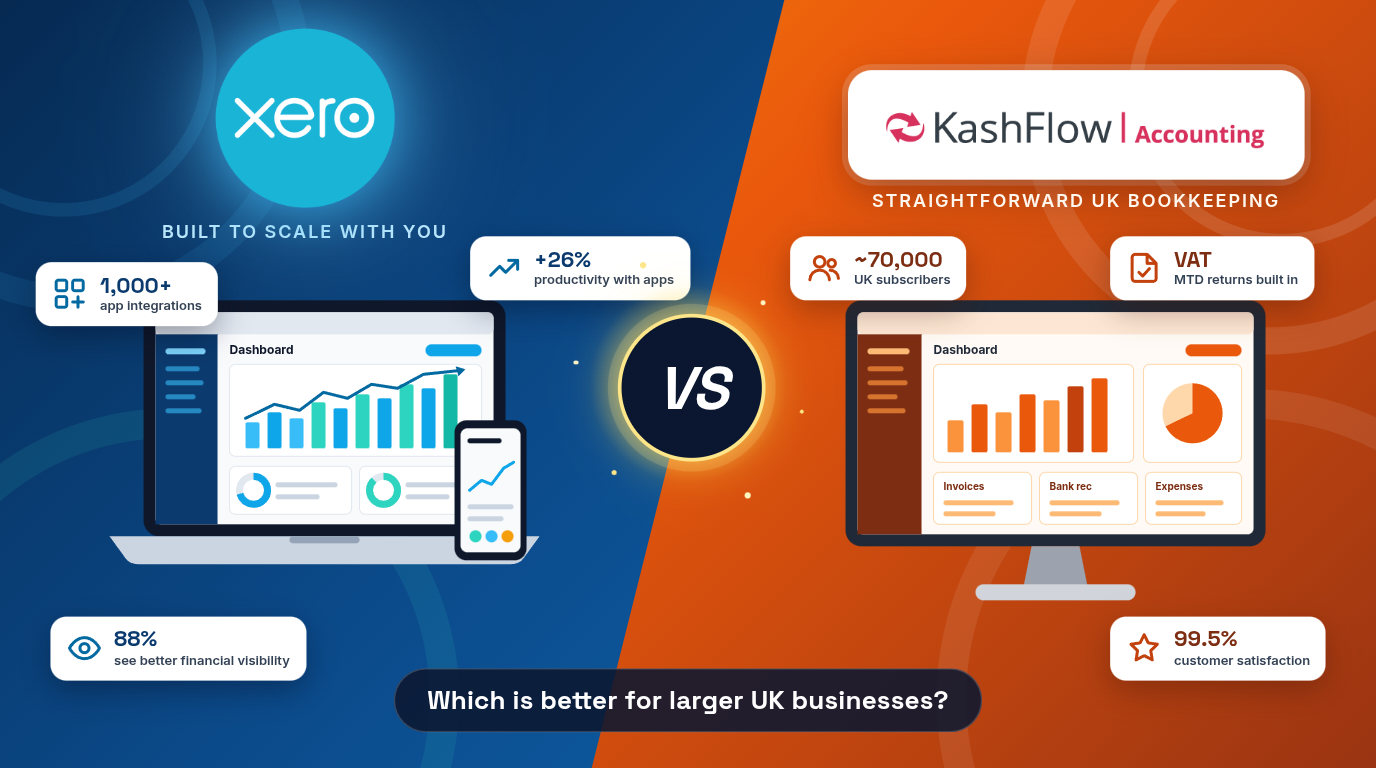
It is also a well-established UK platform and currently reports around 70,000 UK subscribers and a 99.5% customer satisfaction rate, suggesting it continues to work well for businesses that want a straightforward cloud accounting setup.
As the business grows, however, more people may need access to the numbers and reporting requirements can become more demanding.
Xero Has Grown Beyond Its Small-Business Roots
Xero may still be strongly associated with smaller companies, but its use extends well beyond them. HG Insights data published by TrustRadius shows that Xero is not limited to small businesses, with 4,116 tracked installations at mid-sized companies and another 720 at enterprises.
Xero also has a strong following among finance professionals. A survey of 506 UK accountants and bookkeepers found that 32% used or recommended Xero, compared with 8% for IRIS KashFlow.
Those figures do not mean Xero is automatically the better platform. They do challenge the idea that it only belongs with small medium-sized businesses.
Bigger Does Not Automatically Mean Moving to an ERP
Reaching 100 or 200 employees does not automatically mean a business needs Sage, SAP, Oracle, or another large ERP. There are certainly cases where those systems make sense. But headcount alone tells you very little about how complex the finance function actually is.
A larger business may also be able to extend Xero rather than replace it. Customers using Xero's connected apps report an average 26% productivity boost, while the platform supports more than 1,000 integrations across areas such as payroll, inventory, CRM and expenses.
The real test is whether the platform still gives management the information it needs. Xero's current customer research found that 88% say it improves financial visibility across the business, which is exactly the kind of benefit that becomes more important as finance grows more complex.
Xero or KashFlow Depends on What You Need Next
KashFlow can work well when the priority is dependable bookkeeping and relatively straightforward reporting.
Xero becomes more compelling when the business needs greater financial visibility, more people working with the numbers and a finance function that extends beyond keeping the books up to date.
At Sanay, we're Certified Xero Advisors and a Xero Silver Champion Partner, but the value is not the software licence itself. It is the financial expertise, reporting and control built around it.
Need a finance function that can keep up with your business? Speak to Sanay about what you need next.
Read more articles
- Log in to post comments